If you are shopping for a taiko drum, one of the first specifications you may encounter is shaku: 1.3 shaku, 1.5 shaku, 1.8 shaku, 2.0 shaku, and so on. For buyers more familiar with centimeters or inches, those numbers can be confusing. Does 1.5 shaku describe the drumhead diameter, the body height, or the overall size of the instrument?
The short answer is simple: for many common taiko types, the stated shaku size refers approximately to the diameter of the drumhead, not the height of the drum body. One shaku is about 30.3 cm, or 11.93 inches. Taiko Center’s FAQ on taiko sizing explains this convention for Nagado, Hira, Okedo, and Eisa Daiko.
However, shaku should be treated as a nominal size designation rather than a guarantee that every physical dimension will match a mathematical conversion exactly. Handmade instruments, maker-specific proportions, and different drum constructions all create small variations. This guide explains how to read shaku, centimeters, and inches correctly—and why Shime Daiko needs a different approach.
Taiko Drum Size Chart: Shaku to CM and Inches
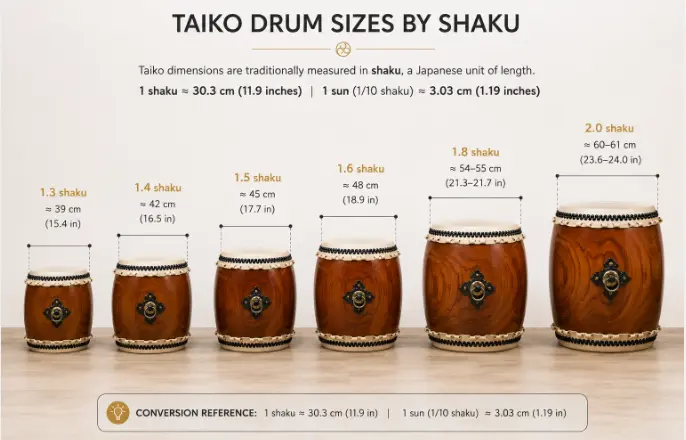
The table below is a practical reference for taiko whose nominal size is expressed by drumhead diameter. The centimeter values follow common maker conventions, while the inch values are approximate and rounded for international buyers. Taiko Center’s size chart and product specifications from major taiko makers use the same general 39–42–45–48 cm progression for 1.3–1.6 shaku sizes.
| Taiko Size | Approx. Head Diameter | Approx. Inches |
|---|---|---|
| 1.0 shaku | ~30 cm | ~11.9 in |
| 1.1 shaku | ~33 cm | ~13.1 in |
| 1.2 shaku | ~36 cm | ~14.3 in |
| 1.3 shaku | ~39 cm | ~15.5 in |
| 1.4 shaku | ~42 cm | ~16.7 in |
| 1.5 shaku | ~45 cm | ~17.9 in |
| 1.6 shaku | ~48 cm | ~19.1 in |
| 1.7 shaku | ~51 cm | ~20.3 in |
| 1.8 shaku | ~54 cm | ~21.5 in |
| 1.9 shaku | ~57 cm | ~22.7 in |
| 2.0 shaku | ~60 cm | ~23.9 in |
| 2.5 shaku | ~75–76 cm | ~29.8 in |
| 3.0 shaku | ~90–91 cm | ~35.8 in |
Conversion note: Inch values are approximate. For product comparison, give priority to the maker’s listed centimeter dimensions.
What Do Shaku and Sun Mean?
One Shaku Equals Ten Sun
Shaku (尺) and sun (寸) are traditional Japanese units of length. The basic relationship is:
- 1 shaku = 10 sun
- 1 shaku ≈ 30.3 cm ≈ 11.93 in
- 1 sun ≈ 3.03 cm ≈ 1.19 in
So “1 shaku 5 sun” is the same nominal designation as 1.5 shaku. A strict mathematical conversion gives about 45.45 cm, but taiko catalogs commonly list that size as approximately 45 cm. TaikoMasa’s Nagado specifications and Asano Taiko’s Nagado catalog both illustrate this maker-friendly rounding convention.
Why Taiko Makers Use Rounded Dimensions
A taiko’s shaku designation is a nominal size category. Natural hides, wooden shells, handcrafted construction, and maker-specific body proportions mean that actual measurements can differ slightly from the mathematical shaku conversion. That is why a practical product listing may use 39, 42, 45, 48, and 54 cm rather than long decimal values.
The most useful rule is: use exact conversion to understand the unit, but use the manufacturer’s actual dimensions when buying, transporting, storing, or matching accessories.
What Part of a Taiko Drum Does the Size Measure?
Head Diameter vs. Body Height
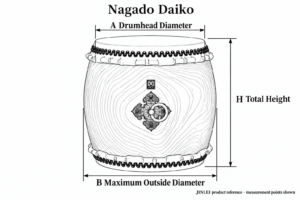
For common taiko such as Nagado, Hira, and Okedo, the nominal shaku size usually refers to the drumhead diameter. Body height or body length is a separate specification. In other words, a 1.5-shaku Nagado means a drum with a nominal head diameter of about 45 cm—it does not mean the drum is 45 cm tall.
JINLEI’s Nagado Daiko range makes the distinction clear: the 1.5-shaku model uses a nominal 45 cm head diameter, while the body height is about 56 cm. A 1.5-shaku Nagado from another maker may have the same nominal head diameter but a different body height, showing why the shaku label does not define every dimension of the instrument.
A JINLEI Example: Same Head Size, Very Different Body Depth
A particularly useful comparison is JINLEI’s 1.5-shaku Nagado and 1.5-shaku Hira. Both have an approximately 45 cm nominal head diameter, but their body depths are dramatically different.
| Drum | Nominal Size | Head Diameter | Body Height |
|---|---|---|---|
| Nagado Daiko | 1.5 shaku | ~45 cm | ~56 cm |
| Hira Daiko | 1.5 shaku | ~45 cm | ~20 cm |
This is the key idea: shaku is not a measurement of total drum volume. It identifies the nominal head-diameter category for these drum types. You can compare current models on JINLEI’s Nagado Daiko and Hira Daiko pages.
Do All Taiko Drums Use the Same Sizing System?
Not exactly. The table below is a better way to read the main taiko categories than applying one universal rule to every drum.
| Drum Type | How Size Is Commonly Stated | What to Check Next |
|---|---|---|
| Nagado Daiko | Head diameter in shaku/sun | Body height, weight, stand and case compatibility |
| Hira Daiko | Head diameter in shaku/sun | Shallower body depth than a same-diameter Nagado |
| Okedo / Oke Daiko | Head diameter in shaku/sun | Body length and stave/rope construction |
| O-Daiko | Usually head diameter / shaku | Actual diameter and maker-specific category naming |
| Conventional Shime Daiko | Namitsuke / 2–5 chō-gake | Maker’s actual diameter, height, head-edge structure and tuning system |
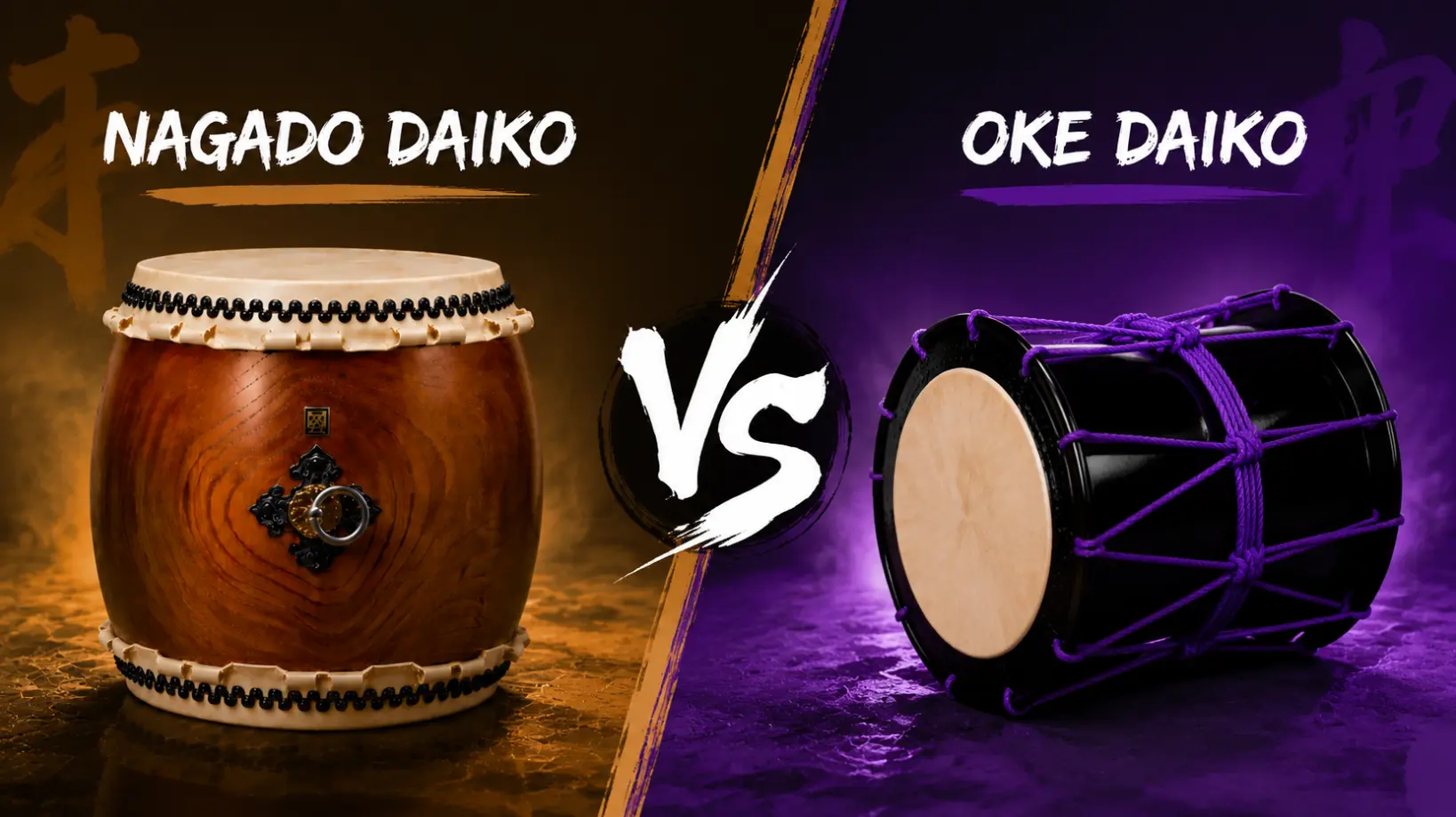
Nagado Daiko
Nagado is the cleanest example of shaku-based sizing. A 1.5-shaku Nagado is nominally around 45 cm across the head, while 1.6 shaku is around 48 cm. JINLEI’s Nagado Daiko collection follows this same convention. For broader context, Taiko Center notes that 1.4-, 1.5-, and 1.6-shaku Nagado are all common sizes in modern taiko groups.
Hira Daiko
Hira Daiko also uses head diameter as the nominal size reference, but its body is much shallower. TaikoMasa’s Hira Daiko page lists sizes such as 1.3 shaku = 39 cm, 1.5 shaku = 45 cm, and 2.5 shaku ≈ 76 cm. So a same-shaku Hira and Nagado may share a head diameter while having very different body proportions and acoustic behavior.
Okedo / Oke Daiko
Oke Daiko is also commonly described by head diameter in shaku, but its stave-built shell and rope-tensioned construction give it different proportions from Nagado. TaikoMasa’s Okedo Daiko reference and JINLEI’s Oke Daiko collection both show why head diameter alone cannot be used to predict the full body dimensions.
O-Daiko
Large-format taiko can still use shaku to describe head diameter, but “O-Daiko” is a category name rather than a separate unit of measurement. The threshold for what a maker calls O-Daiko is not completely universal. Asano Taiko’s O-Daiko catalog provides one maker-specific example, but buyers should always prioritize the actual listed diameter over the category label alone.
Why Shime Daiko Is Different
Conventional Tsuke-Shime / Shime Daiko commonly uses designations such as Namitsuke, 2-chō-gake, 3-chō-gake, 4-chō-gake, and 5-chō-gake rather than relying only on a shaku-to-diameter chart. These grades primarily indicate the thickness category of the drumhead edge. Actual diameter, body height, head construction, and adjustable tension range vary by maker.
That is why a general shaku chart should not be the primary sizing tool for a conventional Shime. Check the maker’s actual dimensions and construction details instead. JINLEI’s Shime Daiko collection uses the same Namitsuke/chō-gake family of designations, while Asano’s Shime Daiko range provides another maker-specific example.
There is an important qualification: not every drum with “Shime” in its name follows the conventional chō-gake system. Certain related instruments, including JINLEI Katsugi Shime Daiko, may be listed with a diameter-based size. Always read the individual specification table instead of relying on the family name alone.
Why Two Taiko With the Same Diameter Can Still Be Very Different
Head diameter is only one variable in a taiko’s design. Two drums can share the same nominal shaku size and still differ significantly in body depth, shell construction, wood, weight, resonance, playing response, transport requirements, and stand or case compatibility.
Shell depth is the most obvious example: a 1.5-shaku Hira and a 1.5-shaku Nagado may both use a ~45 cm head, but the Hira’s shallower body creates a very different resonant cavity. Wood species and shell construction also matter. For a deeper explanation of how diameter, shell structure, wood, hide, and tension interact, see JINLEI’s guide to how taiko drum wood affects sound and guide to tuning and drumhead tension.
How to Read a Taiko Product Size When Shopping
Use a shaku chart as the first layer of product interpretation—not as the final buying decision. A reliable sequence is:
- Identify the drum type first.
- Use shaku to understand the nominal head diameter.
- Check the maker’s actual diameter and body height.
- Confirm weight, stand compatibility, and case dimensions where relevant.
- For conventional Shime Daiko, check the Namitsuke/chō-gake designation and actual maker specs instead of relying on the general shaku chart.
For accessories, actual dimensions matter especially. JINLEI’s Nagado Daiko soft cases are matched to drum-specific dimensions rather than a generic “one-size” conversion, so drums from another brand or with different body proportions may not fit directly. If your next question is not “what does 1.5 shaku mean?” but “which size should I buy?”, consider the player, intended use, shell structure, venue, transport needs, and budget. JINLEI’s guide to choosing the right taiko size and material explains these buying factors in more detail.
What Schools, Dojos, and Taiko Groups Should Confirm
Group purchases require more than a head-diameter comparison. Confirm the players’ ages and heights, the main playing position and stand height, whether each drum will be played by one person or shared, and whether it is intended for lessons, rehearsals, or stage use. Also check the weight and number of people needed for handling, available storage space, door and elevator dimensions, transport frequency, and compatibility with stands, bachi, and cases. For international orders, include the packed dimensions and shipping weight in the planning process.
A 1.5-shaku Nagado, Hira, and Oke may have the same nominal head diameter but require very different playing setups, storage space, handling, and ensemble roles.
Quick Shaku Conversion Formula
For a rough conversion outside the chart:
- Shaku × 30.3 ≈ centimeters
- Shaku × 11.93 ≈ inches
Example: 1.7 shaku × 30.3 ≈ 51.5 cm, or about 20.3 inches. For an actual purchase, the manufacturer’s listed dimensions should still take priority over the calculated value.
Read the Shaku Number in Context
A taiko’s shaku number is useful, but it should never be read in isolation. Remember three points: 1 shaku is about 30.3 cm or 11.93 inches; for many common taiko the shaku size refers approximately to drumhead diameter rather than body height; and nominal shaku size does not guarantee identical overall dimensions across drum types or makers.
Use the chart to understand the nominal size, then confirm the maker’s actual diameter, height, weight, stand compatibility, and case requirements before making a practical decision. That is the most reliable way to compare a Nagado, Hira, Oke, O-Daiko, or Shime without confusing a size label with the complete instrument.
FAQ: Taiko Drum Sizes
What does 1.5 shaku mean on a taiko drum?
For Nagado, Hira, Okedo and other diameter-based taiko, 1.5 shaku usually means a nominal drumhead diameter of about 45 cm, or roughly 17.9 inches. It normally does not refer to body height.
How many centimeters is one shaku?
One shaku is approximately 30.3 cm. Taiko makers often use convenient nominal values, so a 1.5-shaku product is commonly listed as about 45 cm rather than 45.45 cm.
How many inches is 1.6 shaku?
Approximately 19.1 inches. The corresponding nominal head diameter is usually listed at about 48 cm.
Is taiko size measured by diameter or height?
For Nagado, Hira, Okedo and several other common taiko types, nominal size usually refers to drumhead diameter. Body height is a separate specification.
Can two 1.5-shaku taiko have different body sizes?
Yes. JINLEI’s 1.5-shaku Nagado is approximately 45 × 56 cm, while its 1.5-shaku Hira is approximately 45 × 20 cm. They share the same nominal head diameter but have very different body depths.
Are Shime Daiko sizes measured in shaku?
Conventional Shime Daiko commonly uses Namitsuke and chō-gake grades, and maker-specific dimensions should be checked. Some related Shime-family instruments may still use diameter-based specifications, so the individual product table matters.
Does a larger shaku number always mean a larger overall drum?
It usually means a larger nominal head diameter for drum types that use shaku sizing, but it does not define the complete body dimensions. Drum type, shell depth, and construction still determine the overall size.