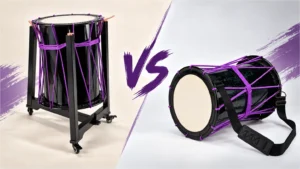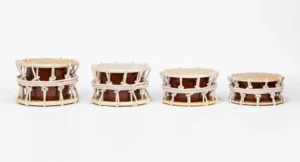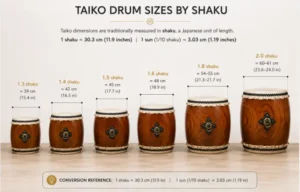
A fitted taiko soft case should be selected from the drum’s actual assembled outside dimensions, not from its nominal shaku size alone. Before ordering, identify the drum type, measure every part that occupies space inside the case, and photograph any rim, rope, bolt, ring, or other projection that creates the widest or longest point.
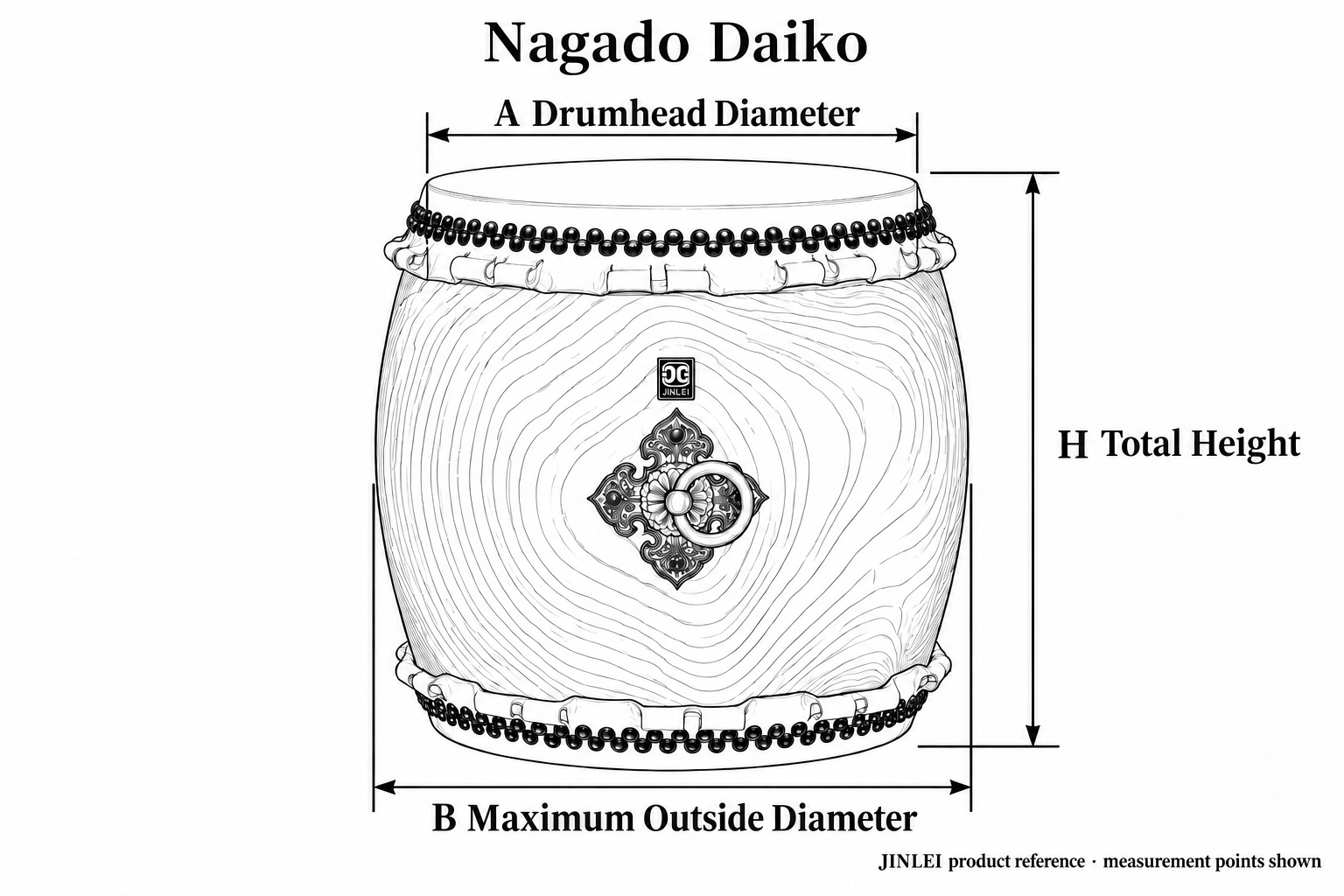
This guide is written for schools, university taiko clubs, cultural organizations, and performing groups that need a repeatable way to measure one drum or a complete inventory. It explains the three reference measurements used by JINLEI: A = drumhead diameter, B = maximum outside diameter, and H = total height or total length.
Product information and JINLEI case references were checked on September 22, 2026. Final compatibility, pricing, customization, and production time should be confirmed for the current order.
Quick Answer: Which Measurements Do You Need?
| Taiko type | Measurements to submit | Parts to check |
|---|---|---|
| Nagado Daiko | A, B, and H | Drumhead, body bulge, leather rims, tacks, and carrying rings |
| Hira Daiko | B and H | Both head rims, tacks, rings, and the complete shallow body |
| Shime Daiko | B and H | Rope loops and knots, hoops, bolts, or turnbuckles |
| Okedo / Oke Daiko | B and H | Head rims, rope crossings, knots, and other projections |
| Katsugi Daiko | B and H | Head rims, ropes, and the strap configuration used for packing |
Record all measurements in centimeters. Submit the actual readings without adding or subtracting a “standard allowance.” The outside dimensions of a drum are not the same as the inside dimensions of a case; padding, openings, closures, and protruding parts all affect the fit.
Before You Measure
Identify the exact drum and packing configuration
Record the drum type, brand, exact model, nominal size, and tensioning system. For a school or ensemble, assign an asset ID to each instrument and include that ID in the photographs. Similar-looking drums can easily be matched to the wrong measurement sheet.
Measure the drum in the configuration in which it will be packed. Do not include the stand. If a shoulder strap is normally removed, state whether it will travel in the same case. Do not remove any normal part of the tensioning system simply to reduce the measurement.
Use the right tools
- A rigid tape measure or straight ruler long enough to span the drum
- A carpenter’s square or two straight, parallel boards for the widest outside dimension
- A thin protective pad for the finish
- A second person for large or unstable drums
Place the instrument on a stable padded surface. Do not compress leather rims, rope knots, or hardware while measuring.
The Three Reference Measurements
A: Drumhead diameter — Nagado only
Measure in a straight line across the top head, through the center, from one drumhead edge to the opposite edge. Do not follow the curve of the hide. Do not include the body bulge or treat the hanging leather edge as the playing-surface diameter. If the two heads differ, record both.
B: Maximum outside diameter — all drum types
Measure the widest straight-line distance across the complete assembled drum. Check several directions and heights. Include any part that determines case clearance: the body, leather rim, rope knot, hoop, bolt, hook, turnbuckle, metal ring, or other fitting.
When the widest point is difficult to span, place two protected parallel boards against opposite outermost points and measure the perpendicular distance between them. A tape wrapped around the curved body measures circumference or arc length, not maximum outside diameter.
H: Total height or total length — all drum types
Measure along the drum’s axis from the outermost surface at one end to the outermost surface at the other. Include both heads, both rims, and any part that adds axial length. For a horizontally positioned Okedo or Katsugi, H means the complete end-to-end length, not the distance from the table to the top of the drum.
How to Measure a Nagado Daiko
A Nagado’s drumhead diameter and widest body diameter can be different. Measure A across the head, B across the widest complete outside profile, and H from the full upper end to the full lower end.
Rotate the drum or check it from another direction so carrying rings, metal mounts, leather edges, and tacks are considered. If a protruding part produces a larger B measurement than the body shown in the diagram, record that larger value and photograph the part.
JINLEI’s Nagado Daiko soft case is tailored to JINLEI Nagado drums. The current product page describes an Oxford-cloth outer material, high-density foam, nylon straps, four side handles, three securing belts, and a water-repellent surface. It also states that fit for drums from other makers should not be assumed.
How to Measure a Hira Daiko
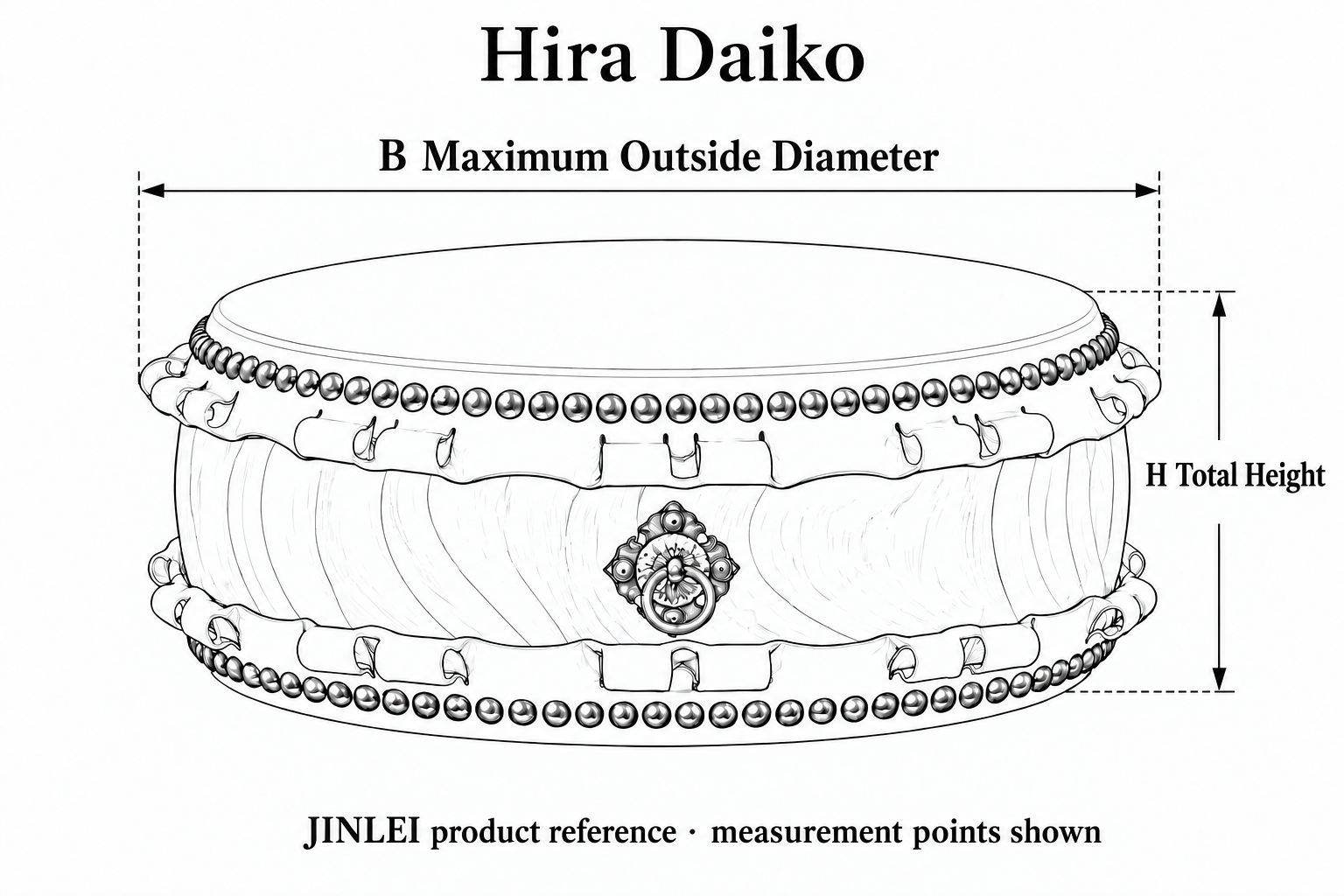
Record B and H. Because a Hira has a shallow body, it is easy to record only the wooden shell depth. The case must accommodate both complete head rims, so measure from the outer surface of one end to the outer surface of the other.
Check the full outline for projecting leather, tacks, or metal rings. A Hira and Nagado with the same nominal shaku label do not have the same proportions and should not be assigned the same case profile.
The current JINLEI Hira Daiko soft-case page lists a water-repellent outer surface, high-density padding, side handles, and a Velcro overlay at the zipper closure. It also notes that the handmade cases are tailored for JINLEI Hira drums.
How to Measure a Shime Daiko
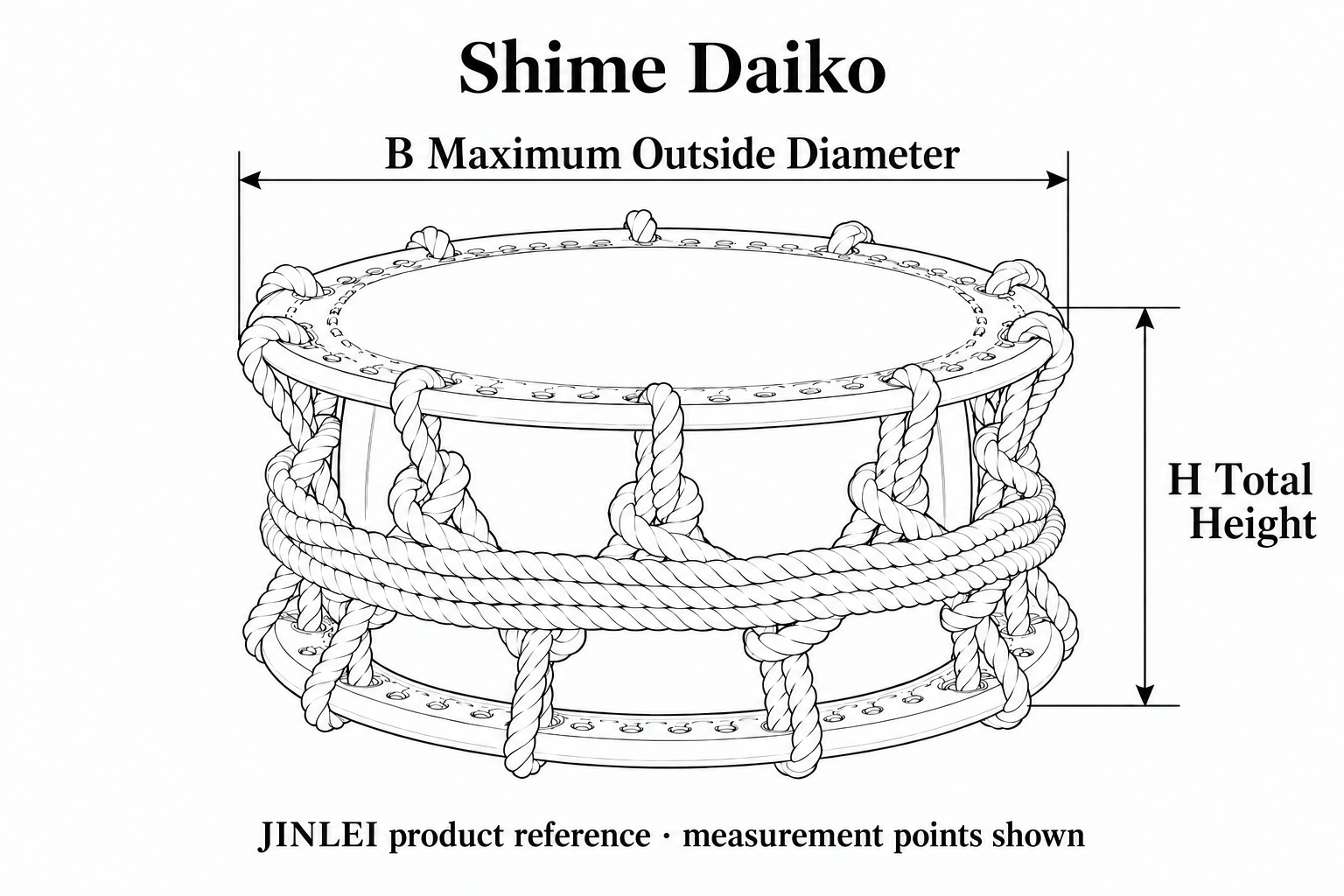
Record B and H from the assembled instrument. For a rope-tensioned Shime, include the complete leather rim, rope loops, and knots. For a bolt or turnbuckle model, check whether the hardware creates the widest or longest point.
Also record the exact specification—such as Namitsuke, 2-chougake, 3-chougake, or 4-chougake—and whether the drum uses rope, bolts, or turnbuckles. A grade name by itself does not establish the assembled dimensions or case compatibility.
How to Measure an Okedo or Oke Daiko
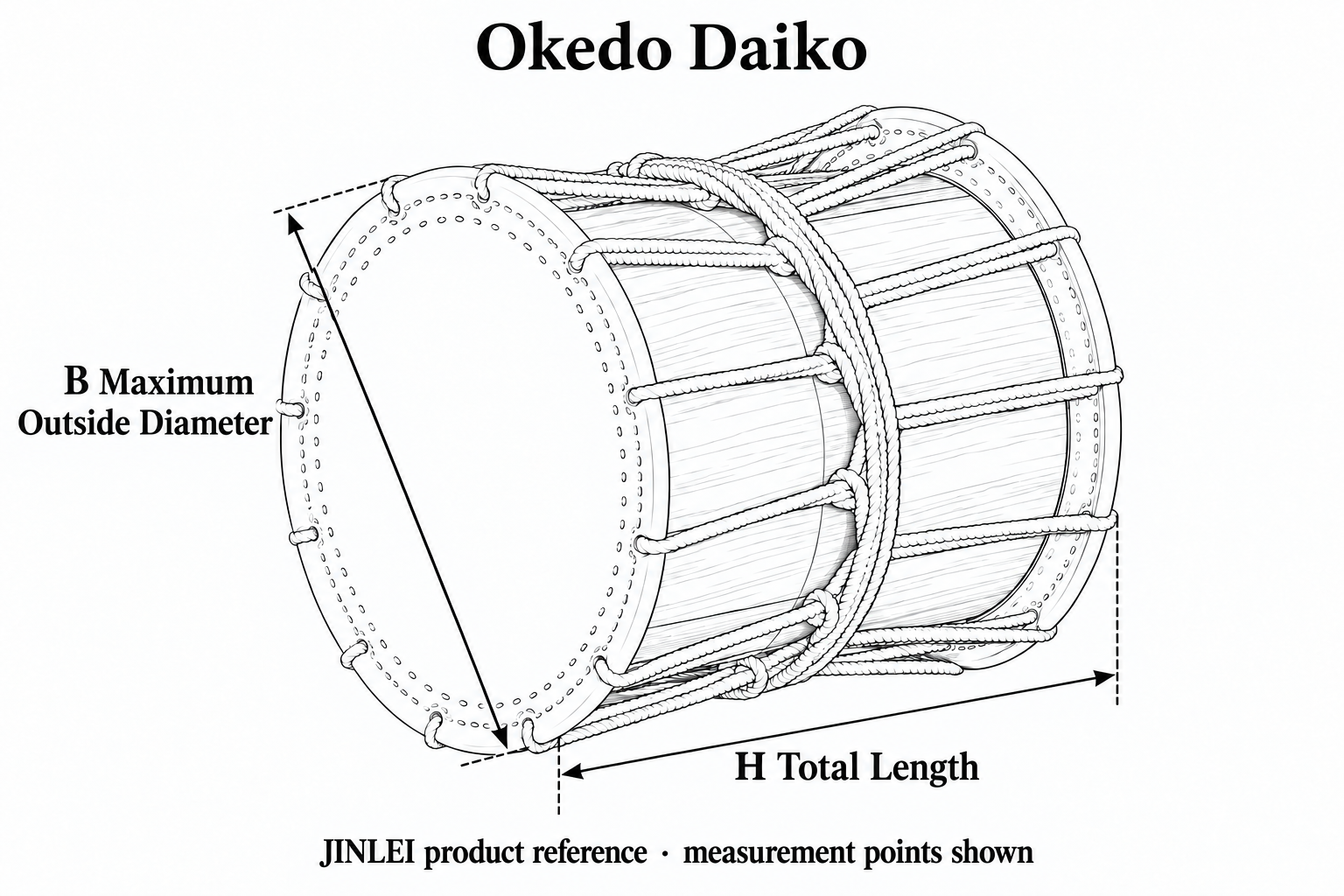
Place the drum horizontally if that makes it more stable. Measure B across the widest complete outside profile and H from the outermost surface of one head to the outermost surface of the other. Check both rims, rope crossings, knots, and any ring or fitting that projects beyond the main outline.
The diagram shows one rope configuration. It should not be used to estimate the dimensions of another tensioning layout. JINLEI publishes a separate Okedou Daiko soft case, with current listings for JINLEI drums and custom sizing available by inquiry.
Katsugi Daiko: Additional Packing Checks
A Katsugi also requires B and H. Measure it separately even when its outline resembles an Okedo. Note whether the playing strap is removed for transport and whether the strap, bachi, or other accessories must be stored in the case.
JINLEI’s Katsugi Daiko soft case has a separate product listing. Its current page describes a water-repellent nylon exterior, high-density foam, a large side zipper, an adjustable shoulder strap, and an inner accessory compartment. Similar nominal dimensions do not prove that Okedo and Katsugi cases are interchangeable.
A Reliable Workflow for Schools and Taiko Groups
Use one measurement record per drum. Measure first, then group instruments only when their type, construction, and actual dimensions match. This approach supports accurate purchasing and makes it easier to keep each case assigned to the correct asset.
- Assign or confirm the drum’s asset ID.
- Record the exact type, brand, model, nominal size, and tensioning method.
- Measure A, B, and H as required.
- Photograph the full front, full side, and the part that creates the maximum dimension.
- Record the measurer and date.
- Ask JINLEI to confirm the standard or custom case before ordering.
When cases arrive, label each one with the assigned drum’s asset ID. Recheck the measurements after a head, rim, rope system, or major hardware component is replaced. For broader purchasing guidance, see Building the First Institutional Taiko Kit for Your School and How to Start a University Taiko Club.
What to Send JINLEI for a Case Quote
- Organization name and delivery destination
- Quantity, drum type, brand, and exact model
- A, B, and H measurements as applicable
- Front, side, and projection-detail photographs
- Asset IDs for multi-drum orders
- Straps or accessories that must be stored in the case
- Preferred delivery date and the date of any fixed event
JINLEI’s current soft-case pages state that standard cases are handmade, slight dimensional variation may occur, and custom sizing is available on request. Published production lead times for the case families referenced above are approximately 2–60 business days, with larger models potentially taking longer. Treat these as current product-page guidance and confirm the schedule for the specific order.
Common Measuring Mistakes
- Ordering from shaku size alone: the label does not capture the drum type, proportions, ropes, or hardware.
- Using drumhead diameter as the complete diameter: a Nagado body or another projection may be wider.
- Wrapping a tape around the body: circumference is not maximum outside diameter.
- Measuring only the wooden shell: include both complete ends and anything that adds length.
- Adding a guessed allowance: submit the actual drum measurements and let the case maker determine clearance.
- Using photographs without measurements: photos document shape and projections but do not provide reliable scale.
- Calling a water-repellent case waterproof: water repellency does not mean complete waterproofing.
Frequently Asked Questions
Can we order a case using only the nominal shaku size?
No. Use the shaku size as identification, then submit the actual dimensions, exact drum type, model, tensioning system, and photographs.
Can circumference be converted to the maximum outside diameter?
That is not recommended for fitting. Handmade rims, rope knots, hardware, and body shapes may not form a perfect circle. Measure the widest straight-line distance directly.
How much larger should the soft case be than the drum?
There is no single allowance that applies to every case. Internal clearance depends on padding, the opening, the closure, and the drum’s projections. Record the drum’s actual dimensions without adjusting them.
Will a JINLEI case fit a taiko made by another brand?
It may, but compatibility should be reviewed rather than assumed. JINLEI’s product pages state that its fitted cases are designed for JINLEI drums and may not fit other makers. Send measurements and photographs for confirmation.
Is a padded soft case suitable for airline checked baggage or freight?
A padded soft case helps with routine carrying, storage, and transport, but it is not the same as a hard flight case or freight crate. Confirm the carrier’s requirements and use appropriate outer protection for checked baggage or freight.
Measure the Drum, Then Confirm the Case
For a school or performing group, a clear measurement record does more than prevent one ordering mistake. It supports future case replacement, equipment assignment, maintenance, and inventory planning.
Send the completed measurements, photographs, quantity, destination, and timing requirements through the JINLEI contact page. Ask for written confirmation of the recommended standard or custom case for each assigned drum before placing the order.
About JINLEI: JINLEI manufactures taiko drums and related accessories for individual players, schools, universities, cultural organizations, and performing groups. Product specifications can change; use the linked product pages and the current quotation as the order-specific source of truth.