A good taiko storage system should make every drum easy to return without placing weight on a drumhead, allowing metal fittings to touch another shell, or trapping damp equipment inside a cover or case. For schools, university taiko clubs, cultural organizations, and shared rehearsal rooms, safe storage is part of the daily teaching workflow—not a separate task reserved for instrument technicians.
This guide explains how to organize Nagado, Shime, Hira, Okedou, Katsugi, and large taiko after class. It focuses on practical risks that appear when several people share the same room: incorrect stacking, shell collisions, crowded access routes, wet cases, misplaced accessories, and long holiday closures.
JINLEI product and care information was checked on September 23, 2026. The storage methods below should be adapted to each drum model, stand, building, and local safety policy.
Start With the Way Your Room Is Used
A dedicated taiko classroom
If the room is used only for taiko, can be locked after class, and has stable stands fitted to the instruments, leaving drums in assigned positions may reduce unnecessary lifting and setup. Use suitable covers when the instruments are idle, or place them in fitted cases when the storage plan requires it.
Keep fixed positions away from direct sunlight, heaters, radiators, and strong air-conditioning airflow. Check whether mopping or cleaning can splash the lower part of a drum or case. A window position that is shaded in the morning may receive direct sun later in the day, so assess the room at more than one time.
A shared room that must be cleared after every session
Create a dedicated storage zone and a repeatable return order. The drums used most often should be accessible without moving several other instruments first. Store stands and accessories close to their assigned drums, but do not leave parts on a drumhead.
When drums cross classrooms, stairs, loading areas, or crowded corridors, a fitted soft case becomes more useful. For short moves inside one room, collision control still matters: the metal ring or handle mount on one Nagado can contact the finished shell of the next drum before the wooden bodies appear to touch.
School holidays and long closures
Before the final session, confirm whether climate control will continue, whether maintenance or construction is planned, and who can enter the room if monitoring shows a problem. Covering or bagging an instrument does not remove the need for occasional inspection.
The First Nagado Risk: Metal Rings Against Finished Shells
When several Nagado are moved into a compact row, look at the drums from the height of their projecting metal rings—not only from above. During turning, removal, or return, a ring may strike or scrape the lacquered shell of the adjacent drum.
- Leave clearance at the height of every projecting ring or fitting.
- Return one drum at a time instead of pushing it between two instruments.
- Before removing a drum, check both sides and choose the direction with the safest path.
- Use floor marks or a reference photo to show the complete storage footprint, including fittings and handling space.
A shell-protector concept for frequently moved Nagado
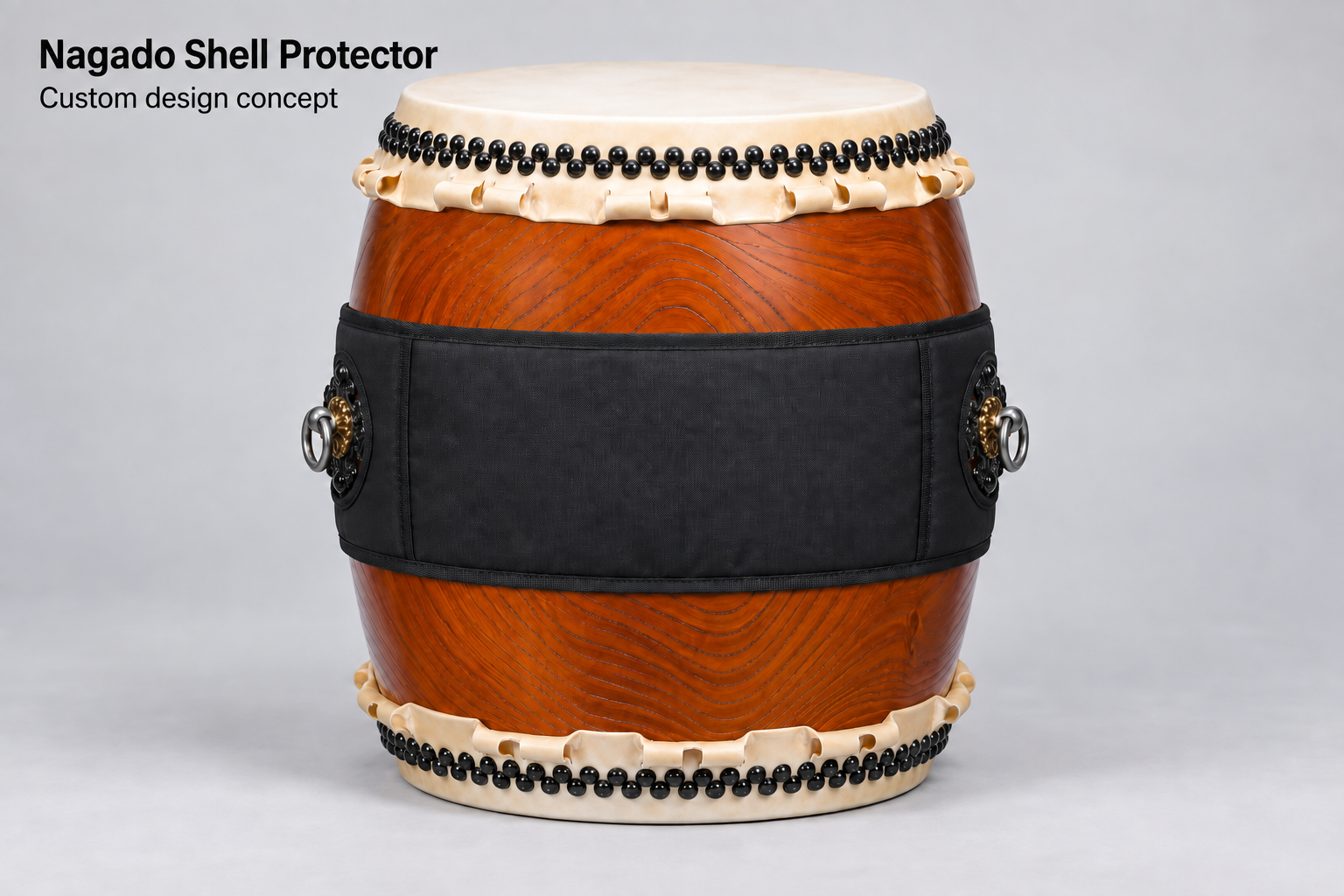
For a classroom that moves many Nagado every day, a removable padded protector around the central shell can add a buffer where neighboring fittings are most likely to make contact. The illustrated concept uses an approximately 20 cm-high central band with openings around the two ring mounts.
This is a custom concept rather than a standard size. Coverage height, shell circumference, fitting-base dimensions, and opening positions must be measured on the actual instrument. A protector must not cover the playing heads, make the drum unstable, or become a lifting handle. Remove it periodically to check that the shell and protector are clean and dry; trapped grit can become an abrasion source.
Do Not Stack a Small Nagado on a Larger Drumhead
Limited floor space can make “large drum below, small drum above” look efficient. A taiko head is a tensioned playing surface, however, not a storage shelf. The lower rim of a smaller Nagado may sit inside the larger drum’s rim and transfer the upper drum’s weight into the playable area.
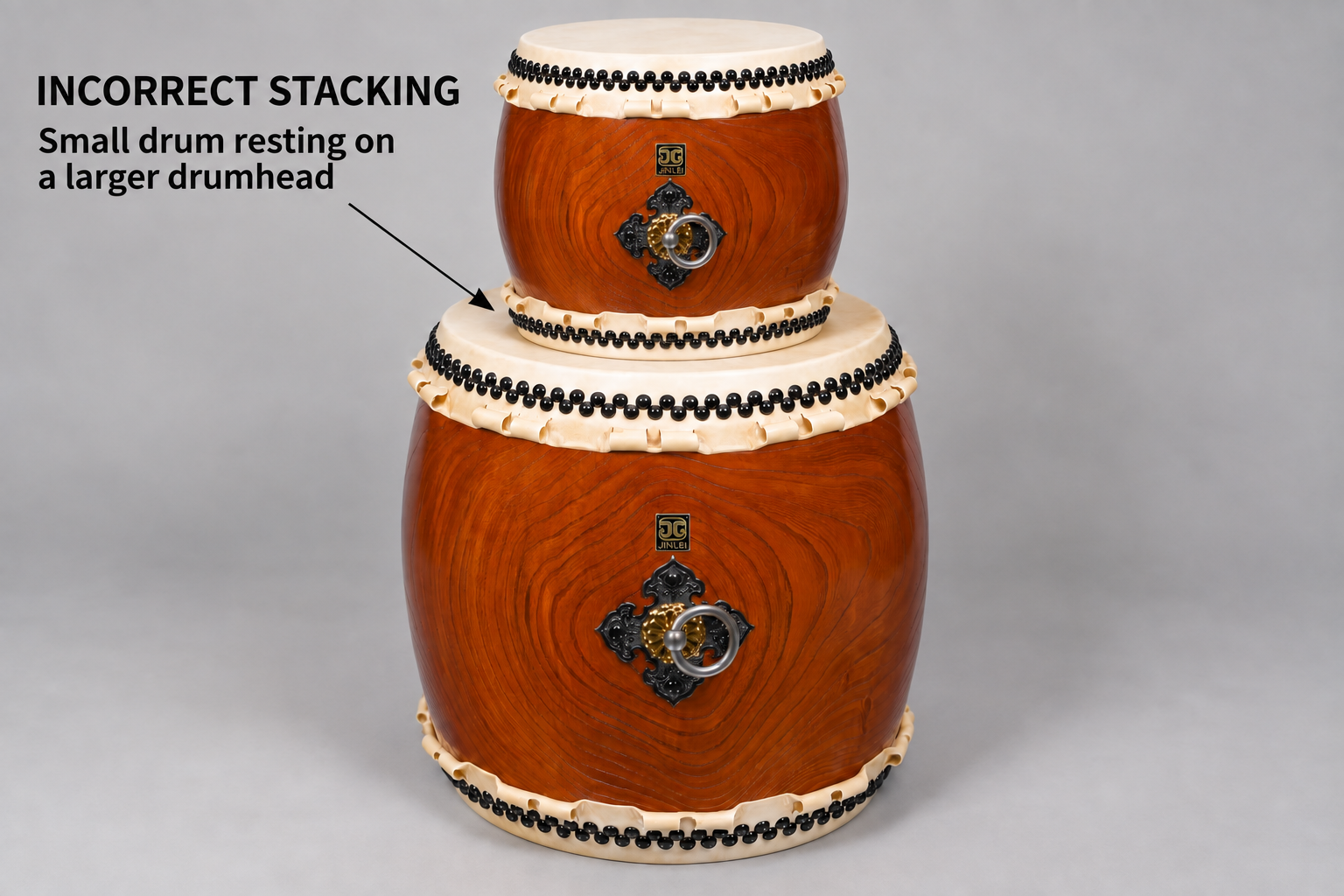
Prolonged or uneven pressure may stress or deform the hide and change its tension. The absence of an immediate dent does not show that the arrangement is safe for long-term storage.
When can stacking even be considered?
Only discuss stacking when the actual dimensions and rim structures are compatible, the contact surfaces align, and the complete stack is stable. A shared nominal shaku label does not prove that drums from different makers or product series have matching rims.
Do not stack when an upper drum is offset, the drums rock, staff must lift heavy instruments above a safe handling height, or access requires repeatedly moving the stack. Different sizes are better stored separately or on a rack where every level independently carries the load.
Never Rest a Bolt-Tensioned Shime on a Nagado Head
A Shime is smaller than a Nagado, so it is often placed temporarily on the larger head. Bolt heads, turnbuckles, hoops, and other metal projections create small contact points. Concentrating the Shime’s weight at those points can mark or damage the Nagado head.
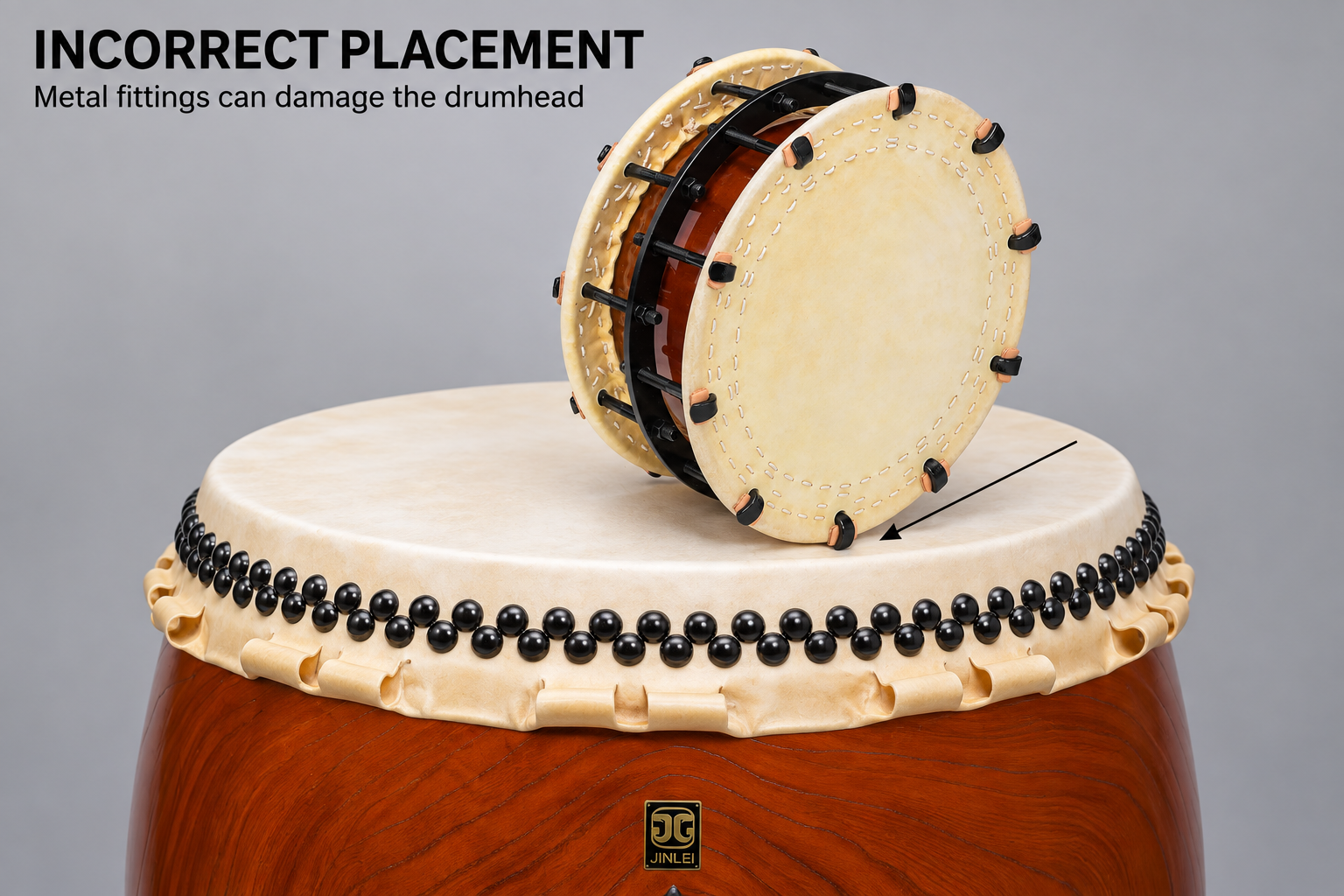
A folded cloth is not a reliable solution because it separates surfaces without turning projecting hardware into a level load-bearing base. Give every Shime its own stand, shelf, case, or assigned storage position. Store tuning tools, bachi, and stand parts in a separate container or dedicated case compartment rather than on any drumhead.
Choose the Right Protection: Cover, Full Case, or Shell Protector
| Protection method | Best use | What it does not solve |
|---|---|---|
| Dust cover | Covering a stationary drum in a dedicated room | Does not provide stable support or control room humidity |
| Fitted soft case | Moving between rooms, performances, transport, and organized storage | Does not correct a poor fit or make a wet instrument safe to seal |
| Custom shell protector | Frequently moved Nagado stored close together | Does not cover the heads and is not a carrying case or handle |
Check the specific material claims before buying a cover. “Dust resistant,” “water repellent,” and “humidity control” describe different functions. A water-repellent outer layer does not guarantee suitable humidity inside.
A soft case also needs the correct dimensions. A zipper closing does not prove a safe fit: a tight case may press fittings, while an oversized case may allow excessive movement. JINLEI’s Nagado soft case is described as water-repellent and padded, and it is tailored for JINLEI drums. Compatibility with another maker’s instrument should be confirmed from actual measurements.
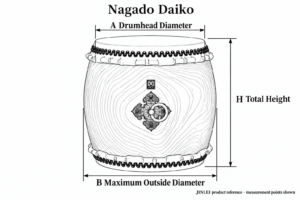
For complete measuring instructions, see How to Measure a Taiko Drum for a Custom Soft Case. Record the head diameter, maximum outside diameter, and total height for a Nagado; record the maximum outside diameter and total height for Hira, Shime, Okedou, and Katsugi. Include normal projections such as rims, knots, bolts, and fittings, without adding a guessed allowance.
Design Storage Around Easy Retrieval and Return
Place frequently used drums where they can be removed directly. Large instruments used less often still need a clear emergency removal route; do not bury them in a corner that becomes inaccessible during a leak.
Mark the complete footprint of each drum, stand, and handling zone. Do not draw a circle based only on the drumhead diameter. Keep racks, folded tables, and other heavy equipment where they cannot fall toward the instruments or require lifting over them.
A board between the drum and floor can separate surfaces, but it does not automatically provide correct support. If a drum is stored horizontally, prevent rolling. Verify the load rating, anchoring, and stability of racks and platforms; padding cannot compensate for an unstable structure.
After arranging the room, run one complete cycle: take out every instrument needed for class, set up, teach, and return everything. Note where another drum must be moved first, where a ring passes too close to a shell, and where equipment blocks a door or walkway.
Storage Differences by Taiko Type
Hira Daiko
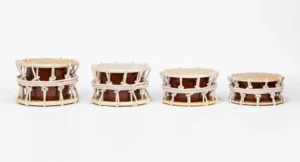
A shallow shell does not make direct drum-on-drum stacking safe. If Hira are stored on multiple levels, each level should support its own instrument rather than using a lower drumhead as a shelf. Cases must be selected for the Hira profile instead of matched to a Nagado by shaku label.
Okedou and Katsugi Daiko
Keep ropes, rims, and connection points away from sharp rack edges or sustained compression. Store straps clean and dry in assigned locations so they do not trail into walkways. Record Okedou and Katsugi separately: their similar outlines do not make their uses, bachi, or cases interchangeable. JINLEI’s FAQ distinguishes lightweight Katsugi construction and Katsugi bachi from the heavier Okedou configuration and wadaiko bachi.
Shime Daiko
Record the tensioning type and keep the drum, stand, and tuning tools together as a set. Whether tension should be adjusted before a long closure depends on the specific model and established maintenance procedure. Do not ask students to loosen or retighten every Shime after each class, and do not apply one holiday procedure to every instrument without model-specific guidance.
O-Daiko and other large instruments
Plan for the drum, stand, doorway, turns, elevator, staffing, and handling equipment as one system. Room area alone does not show whether a large instrument can travel through the route or be safely positioned and retrieved.
A Short After-Class Taiko Checklist
A useful routine should be short enough to follow every time:
- Look for changes. Check for new marks, water spots, shell contact, loose stands, shifted hardware, or displaced ropes. Ask whether anything was dropped, struck, or exposed to rain.
- Remove loose contamination gently. Follow the care instructions for the specific model. Check cases for grit, tools, or damp lining. Do not turn routine storage into sanding, oiling, or chemical treatment.
- Confirm that the drum and protection are dry. Do not seal a visibly damp drum in a case. Avoid hair dryers, heaters, or direct sunlight as shortcuts.
- Return accessories by asset number. Put bachi, tools, and straps in their assigned locations.
- Isolate a questionable instrument. Attach a “Do Not Use” label, photograph the condition, and give it to the responsible staff member for follow-up.
JINLEI’s taiko FAQ recommends dry storage, avoiding direct sunlight, managing humidity, and regularly checking the head and body. Its taiko care guide also recommends wiping sweat with a soft, dry cloth and avoiding strong air vents.
Manage the Room Environment, Not Just One Humidity Reading
A room without air conditioning is not automatically unsuitable, and a room with air conditioning is not automatically safe. Look for persistent dampness, condensation, leaks, direct airflow, and large changes between class hours and closed periods.
If only cases along one wall become damp, investigate the wall, floor, and local water sources. If the entire room smells musty after a closed weekend, review ventilation and temperature-humidity trends while the building is unoccupied.
A reliable temperature and humidity logger can compare class time, overnight conditions, and holidays. Place it where it represents the instruments’ environment, away from a vent or heater. Use model and building guidance to interpret the results instead of treating a single number found online as a universal taiko standard. “Dry storage” does not mean that increasingly dry air is always better.
When using a dehumidifier, plan drainage, power, and unattended operation. A unit that stops when its tank is full may not protect a room throughout a holiday. Open windows only when outdoor conditions support the goal.
What to Do After Water, Impact, or Suspected Mold
Water or a leak
Make the area safe first, especially around electricity and slippery floors. When entry is permitted, document affected equipment and move it to a safe inspection area. Separate wet cases and packing materials from dry instruments. Do not reseal a wet drum or improvise heat drying.
A fall or hard collision
Inspect both the drum and its stand. Photograph the full setup and close views, and record the model, time, and event. Correct underlying causes such as an incompatible stand, loose fastener, blocked route, or unclear handling method.
Unexplained spots or a persistent musty odor
Reduce unnecessary contact and have the responsible staff member arrange an inspection. An odor is a warning sign, not a complete diagnosis. Do not ask students to brush, blow, or spray alcohol, bleach, or other chemicals. Provide the manufacturer or qualified professional with photos and the condition of both the drum and its case.
Prepare for Summer and Other Long Breaks
- Confirm whether climate control will continue.
- Check construction, window, roof, plumbing, and cleaning plans.
- Photograph the room and every instrument before closure.
- Resolve existing damage or dampness instead of hiding it under a cover.
- Remove drinks, wet cloths, and unrelated supplies.
- Confirm monitors have power and that someone will review the data.
- Assign a person who can enter if a problem is reported.
- Inspect stands, fittings, ropes, handles, and case interiors before students use the drums again.
Long-term non-use does not automatically mean that every rope or bolt should be loosened. Keep confirmed, model-specific procedures in the record for that instrument.
Use Simple Records for Schools and Groups
Assign one ID to each drum and connect it to the type, model, measurements, stand, case, storage position, and condition photos. Record borrower, destination, return date, and exceptions when equipment leaves the facility. Daily classes do not need a full repair form.
When budgets are limited, correct the clearest risks first:
- If drums slide or tip, improve support.
- If Nagado rings repeatedly approach neighboring shells, change spacing or evaluate a custom shell protector.
- If drums frequently move between rooms, confirm fitted cases.
- If the room leaks or stays damp, address the environment before buying more covers.
Before expanding the collection, include stands, protection, handling space, and the full access route in the plan. See Building the First Institutional Taiko Kit for Your School and How to Start a University Taiko Club for related purchasing and management guidance.
Five Rules to Post on the Storage-Room Door
- Check Nagado rings before returning a drum; keep them away from neighboring shells.
- Do not place a small Nagado directly on a larger drumhead.
- Do not place a Shime with projecting hardware on a Nagado head.
- Cover or case drums only after the instrument and protection are dry.
- Return cases and accessories by ID; isolate and label anything abnormal.
Place these rules beside one photograph of the correct room layout. Watch how teachers and students use the system, then improve the point where collisions, wrong-case returns, or blocked routes still occur.
Frequently Asked Questions About Taiko Drum Storage
Can schools stack taiko drums to save space?
Do not place a smaller taiko directly on the playing surface of a larger drum. Stacking should only be considered when the actual rim structures align, every contact point is stable, and staff can handle the instruments safely. Separate rack levels that independently support each drum are usually a better choice for shared school storage.
Can a Shime Daiko be stored on top of a Nagado Daiko?
No. Bolt heads, hoops, turnbuckles, and other projecting hardware can concentrate the Shime’s weight on small areas of the Nagado head. Give the Shime its own stand, shelf, fitted case, or assigned storage position.
Should a taiko drum stay inside its case between classes?
A fitted case is useful for transport and organized storage, but the drum and case should be clean and dry before closure. In a dedicated room, a suitable dust cover may be enough for a stationary instrument. Continue to inspect the drum and monitor the room environment.
What humidity level is best for storing taiko drums?
There is no single humidity number that suits every taiko model, hide, climate, and building. Aim for a stable environment without persistent dampness, condensation, direct heat, strong air vents, or sudden swings. Use a reliable temperature and humidity logger and follow model-specific care guidance.
Should rope or bolt tension be loosened during a school holiday?
Do not apply one tension-release rule to every taiko. The correct procedure depends on the drum type, tensioning system, and manufacturer guidance. Keep confirmed instructions with the asset record and do not ask students to make unverified adjustments.
What should a group do if a taiko case or drum smells musty?
Separate the affected item from dry equipment and arrange an inspection by the responsible staff member. Do not seal a damp drum, apply improvised heat, or spray alcohol, bleach, or other chemicals. Photograph the condition and contact the manufacturer or a qualified professional for model-specific advice.
Plan Storage as Part of the Taiko Program
A well-designed storage routine protects the instruments while reducing class setup time. The most effective systems are clear, repeatable, and based on the actual drums and room rather than generic labels.
For product compatibility, fitted cases, or a custom Nagado shell-protector concept, contact JINLEI with the drum models, dimensions, room photos, doorway and turning measurements, storage frequency, and close views of the shell and ring positions.
About JINLEI: JINLEI manufactures taiko drums and related accessories for individual players, schools, universities, cultural organizations, and performing groups. Product specifications and care needs vary by model; current product pages and order-specific guidance should be used when making purchasing or maintenance decisions.