Good taiko maintenance is mostly a routine, not a repair project. A few quick checks after rehearsal can help a school, ensemble, or individual player spot loose hardware, moisture, worn bachi, or storage problems before they become harder to solve.
This schedule covers the equipment around the drum as well as the drum itself: drumheads, shells, stands, straps, bachi, cases, and storage conditions. It is not a guide to retensioning, repairing, or refinishing a drum. If you find damage or are unsure whether something is normal, take photos and contact JINLEI before trying to change it.
One Consistent Care Standard
For routine user care, keep the approach simple: use a soft, dry cloth to remove dust and sweat, then store the instrument in a clean, dry, stable place. Do not use water mist, alcohol, oil, wax, heat, abrasive paper, or improvised repair methods on a drumhead or shell as part of routine care. Older guidance may describe special-case treatments, but the correct method depends on the drum, its condition, and the cause of the problem. Ask JINLEI before taking any action beyond dry wiping and visual inspection.
The Maintenance Schedule at a Glance
| When | Main task | What to look for |
|---|---|---|
| After every use | Wipe down and put equipment away correctly | Moisture, dirt, sharp bachi edges, loose stand parts, safe storage |
| Monthly | Inspect the whole setup | Drumhead condition, shell, hardware, stand, strap, case and accessories |
| Every season or before a major performance | Review the room and transport readiness | Humidity, temperature changes, storage location, moving plan and spare equipment |
| Before requesting service | Document the issue | Clear photos, a short video where useful, model/order details and a description of the change |
After Every Rehearsal: A Five-Minute Routine
1. Wipe the playing surfaces and stand
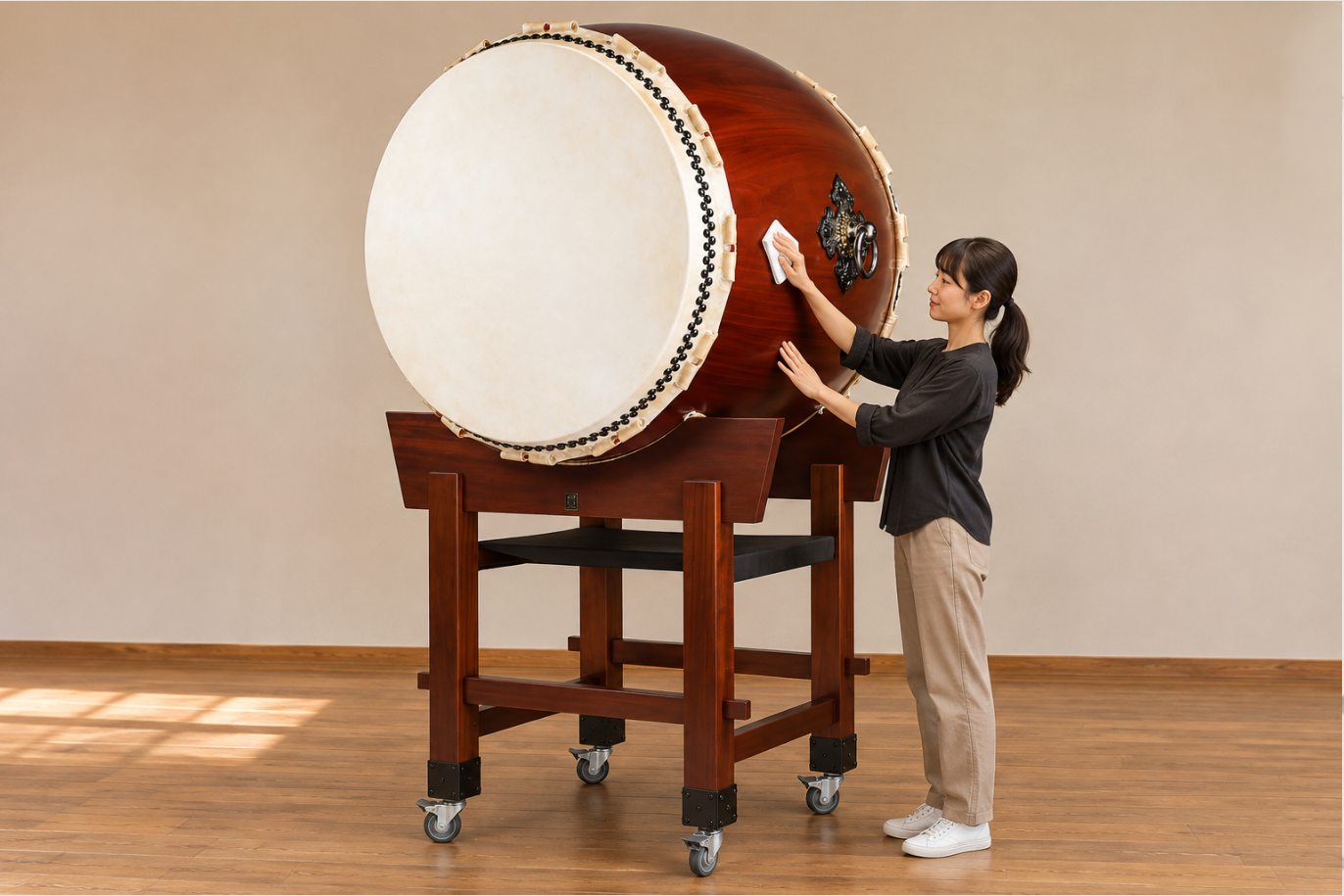
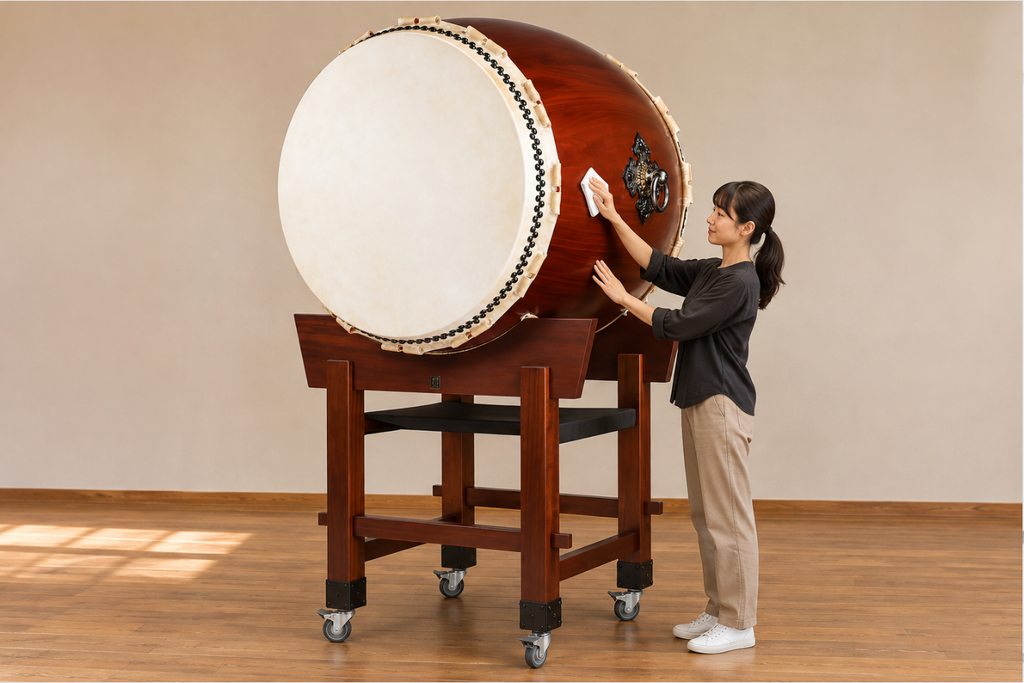
Use a soft, dry cloth to remove sweat, fingerprints, dust, and surface moisture from the drumhead rim, shell, stand, and hardware. Do not soak the cloth or spray liquid directly onto the drum.
Let any case or cover air in a dry, ventilated space before closing it if it has become damp during use or transport.
2. Look at the drumhead before putting the drum away
Check for a new tear, puncture, deep abrasion, unusual roughness, or a visible change around the edge. Also look for marks that may have come from a damaged bachi tip or contact with stand hardware.
Do not try to repair, tape, sand, oil, heat, wet-clean, or retension a drumhead unless JINLEI has confirmed the appropriate action for your drum. A clear photo taken early is more useful than a rushed repair.
3. Check bachi, straps, and small accessories
Run a hand over each bachi. Set aside a bachi with splinters, sharp edges, cracks, or a loose wrap. Check straps for fraying, loose stitching, or damaged attachment points before the next rehearsal.
Put small accessories back in their assigned case or storage location. For groups, this simple habit prevents a missing bachi or strap from becoming a last-minute problem.
4. Store the drum safely
Make sure the drum is stable on its stand or supported as recommended for that model. Keep it away from direct sunlight, damp floors, strong heating or air-conditioning vents, and places where people or other equipment may strike it.
For a more detailed explanation of humidity and storage conditions, see JINLEI’s Taiko Care Guide.
Once a Month: Inspect the Full Setup
Set aside a few minutes to inspect the equipment in good light. For a school or group, make one person responsible for recording anything that needs follow-up.
Drum and drumhead
- Check both heads, where applicable, for tears, punctures, rough patches, mold-like marks, and changes around the rim.
- Look along the shell for new cracks, dents, loose fittings, or finish damage.
- Check rope, bolts, turnbuckles, or other visible tension hardware for anything loose, damaged, or unusual—but do not adjust it without the correct model-specific guidance.
Stand and transport hardware
- Confirm the stand sits flat and does not rock, slide, or lean.
- Check bolts, joints, supports, caster wheels, locks, and protective pads for visible wear or looseness.
- For a large drum, confirm that the stand still supports the drum securely before anyone plays it.
Case, cover, and storage area
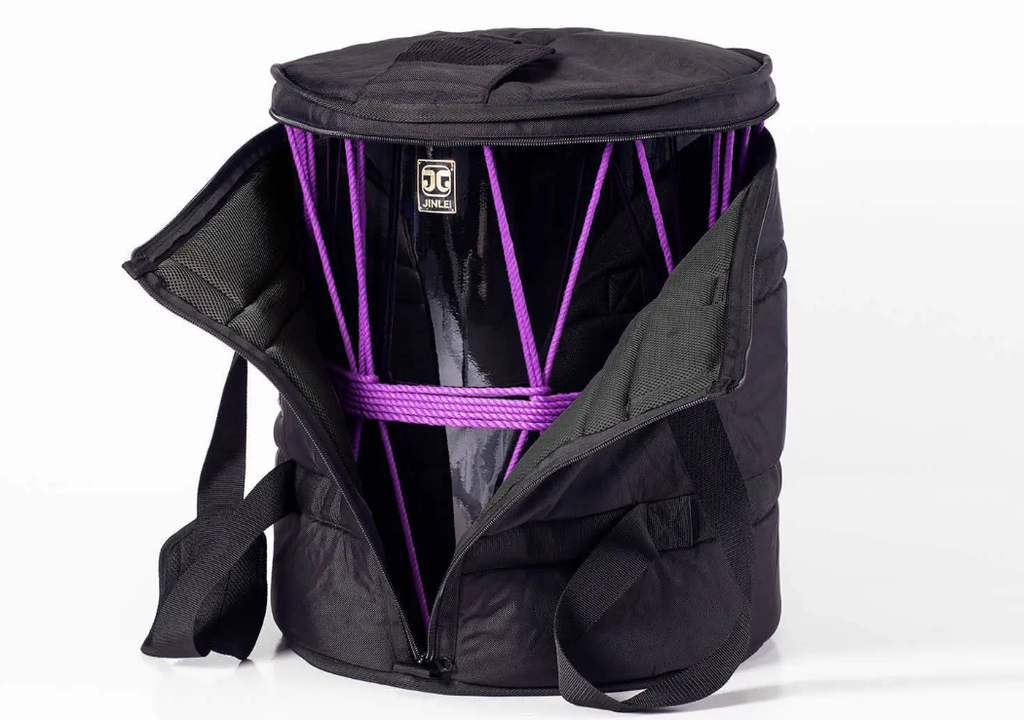
- Check cases and covers for dampness, damaged fasteners, torn handles, or padding that no longer protects the drum.
- Confirm the storage area is clean, dry, and free from direct heat, direct sun, or water risk.
- Make sure heavy equipment is not leaning on a drum, case, or drumhead.
Checkpoints by Taiko Type
The same dry-wipe and stable-storage rule applies to every taiko. The inspection focus changes with the way each instrument is used.
| Type | Routine focus | Stop and ask JINLEI if you find |
|---|---|---|
| Nagado Daiko | Inspect the drumhead rim, shell, stand cradles, and any locking wheels or stand joints. | A crack, loose cradle, unstable stand, or a drum that shifts on its stand. |
| Shime Daiko | Check the matched rope, bolt, or turnbuckle tension system for visible damage, and confirm the correct stand and bachi are being used. | Frayed rope, damaged bolt/turnbuckle, missing hardware, a damaged head, or any need for major tension adjustment. |
| Katsugi Daiko | Check the shoulder strap, attachment points, adjustment hardware, case, and bachi before every moving performance. | Fraying, loose stitching, a damaged attachment point, cracked bachi, or discomfort caused by an unsuitable strap adjustment. |
| Oke Daiko | Check the shell, heads, stand contact points, and the case or cover used for transport. | Movement at the stand, impact damage after transport, head damage, or an accessory that no longer fits securely. |
For Shime Daiko, do not substitute a head, rope, bolt, or turnbuckle system based on diameter alone. JINLEI’s standard grades and tension systems are matched specifications. For Katsugi setups, confirm the correct Katsugi strap, bachi, and fitted soft case before a moving performance.
If You Find a Problem: Stop, Document, Ask
| What you notice | Do now | Do not do |
|---|---|---|
| Drumhead tear, puncture, or deep new abrasion | Stop using the drum, photograph the full head and the affected area, and contact JINLEI. | Do not tape, sand, heat, oil, or retension the head yourself. |
| Stand rocks, wheel/lock is loose, or the drum shifts | Take the drum out of use, prevent it from rolling or tipping, photograph the stand and contact point, then contact JINLEI. | Do not continue playing, shim the stand with improvised objects, or move a large drum alone. |
| Katsugi shoulder strap is frayed, stitching is loose, or attachment hardware is damaged | Stop carrying the drum with that strap, photograph the strap and attachment points, and request guidance or a replacement. | Do not knot, tape, or temporarily sew a load-bearing strap for performance. |
| Unexpected sound or feel after storage, travel, or weather change | Note the model, storage conditions, recent transport, and when the change began; send a short video if useful. | Do not use a hair dryer, water, or unapproved tension changes as a quick fix. |
Every Season: Review the Environment and Your Performance Plan
Temperature and humidity can change quickly between seasons, especially in rehearsal rooms, schools, and touring venues. Before a new season, rainy period, winter heating period, or major performance, review these questions:
- Has the storage room become noticeably damp, dry, hot, or cold?
- Is the drum now closer to a window, heater, air-conditioning vent, or exterior door?
- Will the group move the drums to a different venue or use a different vehicle?
- Do you have suitable cases, straps, covers, and enough people for safe handling?
- Are the bachi and stands still appropriate for the drums being used?
If you notice a sound or feel change after a weather shift, avoid making improvised adjustments. Record what changed, where the drum has been stored, and the model involved; then ask JINLEI for guidance.
Before Transport or a Major Event
Maintenance also means being ready to move the equipment safely. Before loading a vehicle or preparing for a performance, check that the drum, stand, bachi, straps, and soft case all match the plan for that event.
For a new delivery, use the New Taiko Drum Unboxing and First-Use Checklist to inspect the shipment and accessories before the first rehearsal. For existing equipment, create a short loading list that includes:
- each drum and its stand;
- bachi by type and quantity;
- straps, cases, covers, and protective padding;
- spare items approved for the group; and
- the person responsible for the final count.
Do not treat an instrument problem as a backstage repair task. If a drumhead, shell, stand, or strap shows a safety concern, take the item out of use until it has been assessed.
When to Contact JINLEI
Contact JINLEI or the relevant regional service partner before sending a product for inspection or repair. The Sales & Service Network explains how to start that conversation. For an equipment question, repair concern, or replacement recommendation, you can also contact JINLEI with the product link or order number.
Your message will be easier to review if it includes:
- the product model and, if available, order number;
- when you first noticed the issue;
- clear photos of the full drum and the affected area;
- a short video if it helps show movement, sound, or hardware behavior; and
- details of storage, transport, or recent weather changes that may be relevant.
Printable Group Maintenance Record
Print one copy for each drum or shared setup. Tick the result and use the notes column for follow-up.
| Date | Drum / model | Check | OK | Needs follow-up | Notes / person responsible |
|---|---|---|---|---|---|
| ____ | ____ | Dry-wiped drum, stand, and visible hardware | ☐ | ☐ | ____ |
| ____ | ____ | Checked bachi for splinters, cracks, sharp edges, or loose wraps | ☐ | ☐ | ____ |
| ____ | ____ | Confirmed stable storage away from direct sun, dampness, and strong vents | ☐ | ☐ | ____ |
| ____ | ____ | Inspected drumhead, shell, stand, strap, case, and storage area | ☐ | ☐ | ____ |
| ____ | ____ | Reviewed room, vehicle, handling plan, and protective equipment before an event | ☐ | ☐ | ____ |
| ____ | ____ | Photographed and reported any issue before attempting a repair or adjustment | ☐ | ☐ | ____ |
The goal is simple: keep the equipment clean, dry, stable, and easy to inspect. Consistent small checks help a group protect its instruments and make rehearsals easier to run.